
09/01/2026
Stuart J. Lucas
SUNUM - Sabanci University Nanotechnology Research and Application Center
Survival is the constant struggle driving all living organisms – every tissue and organ in our bodies continually carries out a myriad of biological processes to keep us alive, growing and healthy. In order to maintain these processes we need regular energy input from food; shelter and clothing to keep our core temparature within a few degrees Celsius; and above all a constant supply of water. Almost all the biochemical reactions within living cells take place in an aqueous solution – without water, life stops. These basic needs are our biggest challenge as we consider the impacts of climate change and exhaustion of natural resources, or the idea of sending humans into hostile environments such as deep space.
What if there was an animal that could survive almost total deydration? That could go without food indefinitely and be exposed to extremes of temperature and pressure, and yet still recover? Remarkably, some species of Tardigrade – commonly referred to as ‘water bears’ – have exactly this capacity. Tardigrades are 8-legged micro-animals that typically grow to about 0.5 mm in length; roughly the size of the full stop at the end of this sentence. You may well have walked or swum past them without noticing as they can be found wherever there is water, from the upper layers of the ocean to underground streams and mosses and lichens growing on land.
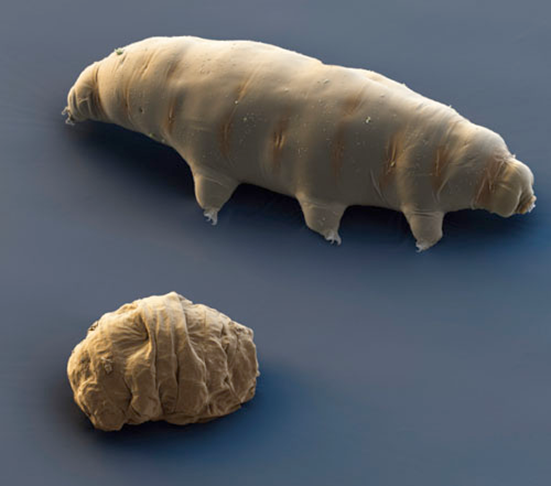
Unlike many small animals, tardigrades do not travel far to seek out more food or water – their name literally means ‘slow walkers.’ Instead, they have developed a battery of survival techniques that enable them to weather environmental changes. If the moss on which a land-based tardigrade lives dries out, it curls up into a ball and gradually loses ~97% of its body water, entering a dehydrated ‘tun’ state. A similar but subtly different process occurs as the temperature drops to freezing conditions. The tun is the key to the animal’s remarkable resilience; almost all biochemical processes are paused and specialized biomolecules protect its essential systems from damage. When water returns, the tun rehydrates back to full size and normal life resumes.
Tardigrades in the tun state have been exposed to temperatures close to absolute zero or well above the boiling point of water, deep frozen for weeks, and even exposed to solar radiation and the vacuum of space in earth orbit; and yet on returning to a temperate environment, they could still rehydrate and recover full biological activity, including growth and reproduction. No other animal can withstand such extreme conditions, which usually destroy the cellular structures on which life depends.
This survivability fascinates scientists – if we understood the structures and mechanisms that help to keep the tardigrade viable in the tun state, could it teach us ways to protect our own cells from damage and disease? Or ways to develop a new types of resilient materials? How about breeding crop plants that are better equipped to tolerate climate change?
One tardigrade molecule that is already being explored for possible applications is the “Dsup” (damage suppressor) protein first isolated from Ramazzottius varieornatus, one of the most resilient species of water bears. Unlike most biological proteins, which are highly structured, Dsup is largely disordered in solution. However, under appropriate conditions it binds to chromosomes within the cell nucleus, protecting the DNA it encapsulates from both chemical and radiation-induced damage. This an intrinsic property of the Dsup protein, demonstrated by the fact the introducing it into cultured human cells or plant tissues also protected their DNA from damage by X-ray or UV radiation.
The handful of tardigrade genomes that have been analysed encode many more proteins that seem to be naturally disordered, but are likely to play a role in protecting or stabilizing other essential molecules in the cell. These ‘tardigrade disordered proteins’ (TDPs) are not found in any other organism, because water bears form a separate branch of the tree of life from other invertebrates such as insects, spiders or crustaceans – literally in a class of their own. Therefore there is still a great deal to be learnt about the diversity of TDPs, their functions and potential applications.
Under the leadership of Prof. Dr. Aydın Türkeç (Bursa Uludağ University/SUNUM) and myself, our recently funded TÜBİTAK research project aims to identify and characterize some of these unique proteins. Collaborating with colleagues at Ankara University, we plan to collect varieties of tardigrade that are unique to Türkiye, focusing on species like Ramazzottius that are known to be highly resilient. Using the molecular biology facilities available at SUNUM we will sequence their DNA and RNA in order to identify genes encoding novel TDPs. Once identified, we will screen them for possible protective effects by inserting the genes into a model plant (thale cress) and a crop plant (potato) and testing whether they increase the plants’ tolerance to environmental stresses such as UV light or drought.
This will only be the first step towards developing novel stabilizers for biological products, or possible applications for sustainable agriculture. But whether we can achieve these goals or something else that we haven’t yet thought of, one thing is certain – we have a lot to learn from nature’s greatest survivalists.